SILKWORMS
A research project that translated silkworm spinning behavior into a procedural Houdini tool, then applied the resulting pattern to consumer products as a proof of concept for computational biomimicry in design. Winner of Best Student Paper at the 2025 E&PDE Conference in Malta.
(CHALLENGE)
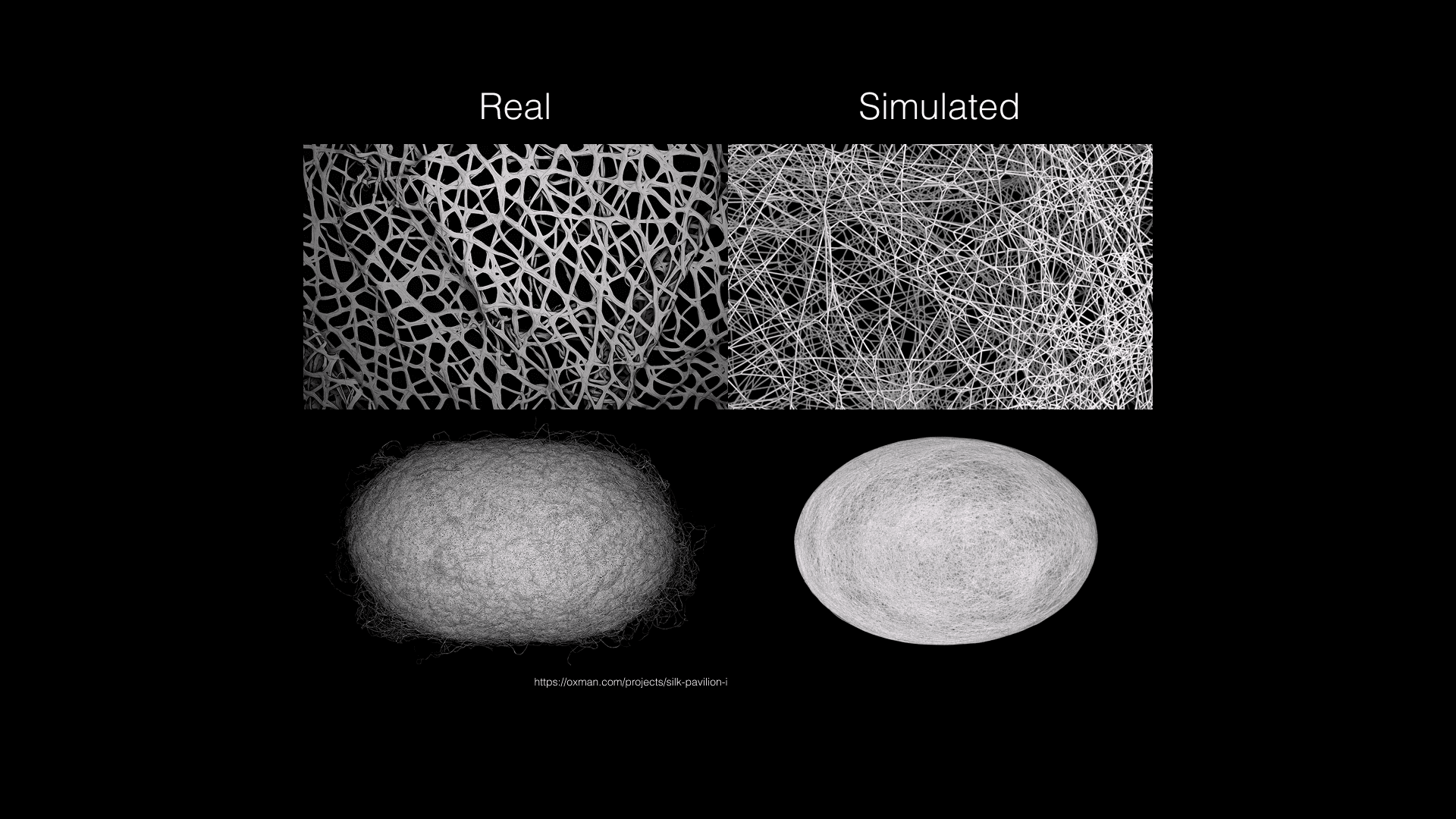
Nature produces patterns with an organic randomness that digital tools struggle to replicate convincingly. The question was whether a living organism's behavior could be observed closely enough to encode into an algorithm that reproduces the same visual and structural qualities on any surface. I raised Bombyx mori silkworms on flat 3D-printed pedestals. Without vertical anchor points to build a cocoon, they spin flat, non-woven silk sheets instead, which exposed their behavior as a readable 2D pattern.


(OUTCOME)
From that documentation I built a custom Houdini node that scatters points, links them by proximity, then resamples, fuses, smooths, and polywires them into strands. The system reproduces the layering, randomized paths, and edge constraints of real silk, and comparison against the physical sheets confirmed its fidelity. Applying it to a Noguchi-style lamp shade and a t-shirt pattern showed that it adapts to arbitrary geometry across product categories.